
Quick summary (TL;DR)
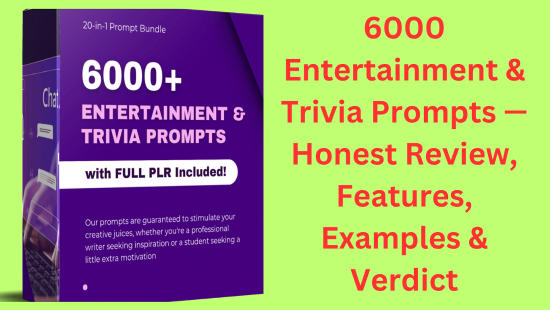
6000 Entertainment & Trivia Prompts is a large prompt pack designed for creators, party hosts, trivia-makers, educators, streamers, and social media managers who need ready-made entertainment questions and creative prompt ideas. It aims to save time, spark engagement, and provide flexible material for games, videos, quizzes, and classroom activities. Strengths include sheer volume, variety across topics and difficulty levels, and plug-and-play usability. Weaknesses are repetition risk without curation, variable depth in quality, and limited customization guidance in some versions. Overall: excellent timesaver and idea-generator — especially valuable if you regularly need fresh, shareable content.
What is it?
At its core, 6000 Entertainment & Trivia Prompts is a collection of prompts and trivia questions organized to help users create engaging experiences quickly. The pack usually includes:
- Straightforward trivia questions (general knowledge, pop culture, history, science)
- Entertainment prompts (icebreaker questions, “this-or-that”, would-you-rather, “finish-the-lyric”, movie/TV topic starters)
- Game-ready sets (rounds for pub-style trivia, rapid-fire lists, tiered-difficulty stacks)
- Prompts tailored to formats (Instagram stories, YouTube shorts, TikTok challenges, livestream audience polls)
- Bonus content such as answer keys, suggested scoring methods, and sometimes printable layouts or slide templates.
The product markets itself as a plug-and-play library: copy, paste, adapt, and go live — no research required.
Who is this for?
This pack is aimed at a surprisingly broad audience:
- Quiz hosts & bar trivia hosts who need many rounds and themes.
- Teachers & tutors looking for quick warm-ups or classroom games.
- Streamers & podcasters wanting audience engagement prompts.
- Social media managers & content creators who must post fresh, interactive content daily.
- Event planners & party hosts organizing icebreaker sessions or themed nights.
- Writers & game designers needing inspiration for characters, challenges, or mini-games.
If you rarely run trivia or rarely post interactive content, the volume may be overkill. But if you produce recurring entertainment or educational content, the pack can be a time-saver and inspiration bank.
What’s inside — breakdown by section
Although editions vary, a typical structure looks like this:
- General knowledge trivia (1,500–2,500 prompts)
— Wide-ranging Q/A across categories: geography, science, literature, sports, music. - Pop culture & entertainment (1,000–1,500 prompts)
— Movie trivia, celebrity facts, TV shows, gaming, memes, viral moments. - Kids & family-friendly prompts (500–800 prompts)
— Simpler language, safe-for-school content, fun facts. - Icebreakers & party prompts (700–1,000 prompts)
— “Would you rather?”, “Two truths and a lie”, conversation starters, charades ideas. - Social-media-ready micro-prompts (300–600 prompts)
— Caption prompts, poll questions, story templates, challenge ideas. - Themed rounds & mini-games (200–400 prompts)
— Round formats: picture round ideas, music intro rounds, lightning rounds. - Answer sheets, scoring suggestions, and formatting tips (varies)
— Helpful if you want ready-made printable rounds or slides.
This mix gives a balance of depths and formats — not just random questions but usable structures to build events and content.
Quality & accuracy
Because of the volume, quality varies. Expect:
- A high proportion of useful, accurate general-knowledge questions.
- Pop-culture items that date quickly (so they’re great in the short term but may age).
- Some questions that are ambiguous or require careful wording to avoid disputes — especially with trivia where phrasing matters.
- Occasional mistakes or minor factual errors (common in large compilations); it’s wise to quickly verify scores/answers for public competitions.
Practical tip: If you use this commercially (paid events, competitions), proofread and verify the answer keys for the specific items you’ll run. For social media and casual use, it’s usually fine as-is.
Usability & formats
The pack is designed to be usable immediately:
- Formats included: plain text lists, CSV or spreadsheet-friendly layout, and sometimes PDF printables or slide-ready layouts.
- Copy/paste friendly: prompts are short; you can easily paste into streaming software, slides, polls, or social media schedulers.
- Searchability: the best editions include categorized folders or spreadsheets so you can filter by category and difficulty. Cheaper versions may be one long list — more time to curate, less immediate convenience.
If you produce weekly shows or frequent posts, the spreadsheet-friendly versions are gold — they let you assemble rounds in minutes.
Unique strengths
- Massive variety: 6,000 prompts reduce creative fatigue and repeated themes.
- Multi-platform utility: useful for live events, classroom, and social formats.
- Time-saving: reduces research time from hours to minutes.
- Inspiration + structure: not only questions but rounds and game ideas.
- Adaptable: prompts are short and editable, easy to tailor to audience age or tone.
Limitations & what to watch for
- Repetition risk: across 6,000 items, topics can repeat unless well-indexed.
- Aging pop culture: some prompts become irrelevant quickly—plan to swap these out.
- Verification needed for accuracy: particularly for wagers or paid trivia.
- Quality spread: not every question is equally clever or well-phrased.
- Formatting differences: editions vary — check whether you get spreadsheets, PDFs, or just text.
Sample prompts (realistic examples)
Here are a few example prompts you can expect — copy/paste ready:
General trivia
- Q: Which planet is the hottest in our solar system? (A: Venus)
- Q: Who wrote Pride and Prejudice? (A: Jane Austen)
Pop culture
- Q: Which film won the Academy Award for Best Picture in 1994? (A: Forrest Gump)
- Q: Which band released the album Dark Side of the Moon? (A: Pink Floyd)
Icebreaker
- Prompt: “If you could have dinner with any fictional character, who would it be and why?”
- Prompt: “Two truths and a lie — share three short facts; we’ll guess the lie.”
Social micro
- Poll: “Which 90s TV show deserves a reboot? Vote: Friends / The X-Files / Buffy.”
- Caption prompt: “Describe today using only emojis — go!”
These illustrate the pack’s range from precise Q/A to open-ended engagement prompts.
How to use it — practical workflows
- Streamer routine: Pick 10–12 social micro-prompts for chat polls each stream; rotate themed trivia rounds weekly.
- Teacher routine: Use 8–10 family-friendly Qs as warm-ups or a 20-question quiz for a class period.
- Event host routine: Assemble three themed rounds (10 questions each) and one picture round using the themed-round suggestions.
- Social manager routine: Schedule 3–4 engagement prompts weekly; pair with visuals or quick videos to boost reach.
Pro tip: Tag each selected prompt with a content purpose (e.g., “poll”, “quiz-round-1”, “icebreaker-teen”) in a spreadsheet so you can reuse and adapt without repeating.
Pricing & value
Price perceptions depend on how much you’ll use it. If you run weekly events, classrooms, or frequent social content, the pack typically pays for itself quickly by saving planning time. For occasional users, a smaller, curated pack might be more economical. Since versions differ (basic text vs. curated spreadsheet vs. slide templates), check exactly what format you’ll receive before purchasing.
Alternatives & complements
- Smaller themed packs (e.g., “Movie Trivia 500” or “Science Quiz 800”) — useful if you focus narrowly.
- Subscription services or live-trivia platforms that generate dynamic questions (more expensive but fresh).
- Custom-built question banks using community-sourced trivia — can be free but require curation.
A smart approach: use 6000 Entertainment & Trivia Prompts as your backbone, and rotate in fresh, topical questions from current events for relevance.
Pros & Cons (quick list)
Pros
- Huge quantity — you’ll rarely run out of ideas.
- Multi-format utility — fits many platforms and event types.
- Saves planning time and reduces creative friction.
- Easy to adapt and brand for your show/event.
Cons
- Variable quality — watch for typos and factual slip-ups.
- Pop-culture items can date quickly.
- Can feel overwhelming without good organization.
- Some versions lack polished formatting or slide-ready assets.
Final verdict
6000 Entertainment & Trivia Prompts is a robust, pragmatic tool for anyone who regularly needs audience interaction, quiz content, or party games. Its main selling point is volume paired with variety — if you run weekly events, stream often, or manage social engagement, this pack will become a dependable part of your workflow. The trade-off is that you must curate and occasionally fact-check; the product is a productivity multiplier, not a replacement for an attentive host or educator.
If you value time-savings and fresh ideas more than hand-crafted, bespoke questions, this is a strong buy. If you only need sporadic trivia, consider a smaller pack or sampling before committing.
Quick setup checklist (get started in 15 minutes)
- Open the file and scan categories.
- Copy a 20–question set and check tricky answers.
- Format into your platform (slide, chat bot, Google Form).
- Tag each prompt with date and purpose for reuse.
- Run 1 trial round in a low-stakes setting, then iterate.
FAQ
Q: Are the answers included?
Usually yes — most versions include answers and sometimes brief explanations.
Q: Can I use this commercially (paid events)?
Yes, but verify the seller’s license/terms. Also double-check high-stakes answers before using them in paid competitions.
Q: Is the content copy-paste ready?
Yes — that’s the main draw. Better editions provide spreadsheet columns for category, difficulty, and answer.
Q: Will it replace my need to research current events?
No — for topical trivia (news, trending memes), you should supplement with up-to-date questions.
How to get the most value
- Import the prompts into a spreadsheet and add your own tags.
- Create reusable rounds (e.g., “Movie Night Round A”) and rotate them.
- Mix evergreen general-knowledge with topical pop-culture questions.
- Use social prompts as engagement magnets — pair them with images or short videos.
- Maintain a single “verified” list for high-stakes public events.
More read: How to Make Podcast Videos with AI Using MagicPods AI
AICora Review 2025 – Smart AI Tool for Social Media Automation
Pingback: PodGorilla Review: Create AI Podcasts Effortlessly